The Deed and the Drain playtest
Research checked November 6, 2026. The story references include opening spoilers for The Greatest Estate Developer and material from the licensed Ascendance of a Bookworm manga’s Part 1, volumes 4 and 5. Ternford, its public works, and its rules are original.
Story and game references
| Source | What the source shows | What the prototype tests |
|---|---|---|
| The Greatest Estate Developer, opening comic | Lloyd uses a floor-heating demonstration to establish a service people will pay for. His inherited position also comes with a debt that creditors can call in. The two activities take place alongside one another, giving him a practical project and a financial deadline. WEBTOON episode 2 · Episode 3 | A built project improves the town. The separate debt bill remains due. Players have to schedule work that earns cash as well as work that builds infrastructure. |
| Ascendance of a Bookworm, Part 1 manga | Benno’s contract gives Myne and Lutz a route to tools and materials. They subsequently go to the Merchant’s Guild to register so they can sell the finished paper. Their recipe, manufacturing ability, and authorization to sell are separate problems. J-Novel Club, Part 1 volume 4 summary · Yen Press, Part 1 volume 5 summary | The grower’s easement is its own crew order and costs one coin. Knowing the cheapest drain route and having money for construction still leaves permission to secure. |
| Against the Storm | Eremite’s tutorials isolate trade and the conditions around rain in small replayable scenarios. One scenario encourages a trading strategy through its orders and blueprints. Eremite developer notes | Put one rain event and one income action in the first run. Players can work for the market before rain and experience a direct consequence if they leave it unprotected. |
| Frostpunk | Lead designer Kuba Stokalski describes resource planning and infrastructure alongside the choices made about the people who live and work in the city. Developer article on PlayStation.Blog | Track money, repayment, permission, lost crops, and flooded stalls as separate outcomes. A solvent result can still have a visible community cost. |
Playable rules
Open /game-lab/play/the-deed-and-the-drain/ from Manga Atlas’s Game Lab. Choose a map pin to focus the corresponding work orders, or choose All sites. Tab to a work order and press Enter or Space. End the day with the button or by pressing E while focus is in the game. Restart clears the survey.
- Start with seven coins, four coins of debt and two crew shifts per day. A work order consumes one shift. The first construction order for a route pays its full cost and commits the route.
- The farm cut costs two coins and two shifts after a signed easement. Obtaining the easement consumes one shift and costs one coin. Beginning the cut clears one crop strip. The riverbank drain costs six coins and three shifts and leaves the farm intact.
- The Farm Lane approach costs three coins and two shifts. It occupies the same lane as the farm cut. The ridge approach costs four coins and three shifts and uses a separate alignment.
- Hauling for the stallholders pays two coins once per day. The lender offers three coins in exchange for five additional coins due at settlement. That advance can be taken once.
- Rain falls after day three. A finished drain or raised boardwalk keeps both stalls dry. With neither finished, two stalls flood and hauling closes on day four. Completing the drain later leaves those losses in the community ledger.
- The commission checks both core works and collects the debt after day six. Finish both and pay the debt to win. Finish any two town improvements as well to earn the town charter. The work journal records which day a consequence occurred.
Town improvements
| Project | Cost and access | Effect |
|---|---|---|
| Raised boardwalk | One coin and one shift. Orders close after day three. | Keeps both stalls dry and hauling open if the drain is unfinished when the rain arrives. The full drain is still required for the commission. |
| Covered granary | Three coins and two shifts. Timber deliveries need a completed cart approach. | Hauling earns four coins after it is built. It normally earns two. |
| Crew lodge | Two coins and two shifts. Complete at least one paid haul before inviting the crew to move in. | A third shift becomes available from the following day. |
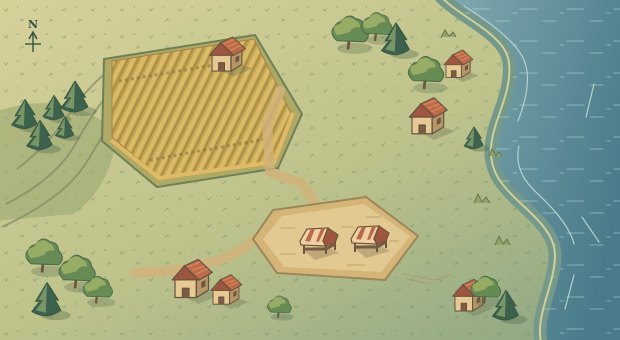
The illustrated Ternford map uses local art. Routes show the portion built, while the lodge and granary show scaffolding during construction and finished structures afterward. The boardwalk goes up in one shift. A cleared crop strip or flooded market stays visible alongside the Treasury and Community accounts. The calendar shows the current day and flags the two deadlines.

Two charter plans
Issue the listed orders before ending each day. Both plans settle the debt, earn the charter and retain one coin. The riverbank plan spends on a boardwalk early and keeps the crop strip. The farm plan clears that strip by agreement and uses the granary’s higher payout to settle its accounts.
| Day | Farm cut, lodge and granary | Riverbank drain, lodge and boardwalk |
|---|---|---|
| 1 | Haul, start the lodge | Haul, start the lodge |
| 2 | Finish the lodge, sign the grower’s easement | Finish the lodge, build the boardwalk |
| 3 | Build the farm cut twice, start the ridge approach | Start the bank drain, haul, work on the bank drain. The boardwalk protects the stalls at dusk. |
| 4 | Finish the ridge approach with two shifts, haul | Finish the bank drain, haul, start the Farm Lane approach |
| 5 | Haul, build the granary twice | Finish the Farm Lane approach, haul |
| 6 | Haul for four coins | Haul |
Two solutions and a losing fixture
Each table cell gives orders to issue before ending that day. The two successes use the same seven-coin starting treasury. The farm solution has one crop strip cleared with consent and fewer hauling shifts. The bank solution keeps the crop strip and requires one additional hauling shift.
| Day | Farm cut and ridge approach | Riverbank drain and Farm Lane approach |
|---|---|---|
| 1 | Sign the easement, start the farm cut | Start the riverbank drain, haul |
| 2 | Complete the farm cut, haul | Work the riverbank drain twice |
| 3 | Start the ridge approach, haul | Start the Farm Lane approach, haul |
| 4 | Work the ridge approach | Complete the Farm Lane approach, haul |
| 5 | Complete the ridge approach | End the day |
| 6 | End the day | End the day |
Both solutions repay four coins and finish with zero coins in the treasury. Neither floods a stall. In the insolvency fixture, take the loan, complete the riverbank drain and Farm Lane approach, and skip hauling. Both works finish but the treasury has one coin against nine due. For the flood fixture, leave the drain unfinished through day three and confirm that hauling is unavailable on day four.
Season Two — The winter stores
Any settled first commission unlocks Continue to Season Two. The winter audit comes after five days and requires at least four sacks of grain, five coins and every stall open. The opening treasury includes the remaining first-season coins and a three-coin council grant. An intact crop strip contributes two sacks. A cleared strip contributes one. The journal and map retain the actual works, and any flooded stalls start the winter season closed.
| Schedule | Decision and consequence |
|---|---|
| Day 2, drought | One shift and one coin dig an irrigation feeder. Without it at dusk, households use one sack if available and harvesting stops. A later feeder reopens harvesting. Imported grain costs two coins for two sacks and is available throughout the season. |
| Day 3, caravan closes | One shift sends two sacks for six coins along Farm Lane or five along the ridge. Local hauling pays two coins once per day and uses no grain. A granary adds one coin per haul. Both types of trade need open stalls. |
| Day 4, river surge | Clear the inherited drain in one shift for the bank route or two for the farm cut. A finished boardwalk protects the stalls even if the drain is uncleared. A granary keeps stored grain dry. Open storage loses one sack if stocked. |
| Day 5, winter audit | Two coins and one shift reopen every closed stall. Last-day repairs count toward the audit. End with the required reserves and all stalls open. |
Most steward’s orders use a shift. Harvesting yields two sacks once per day, and an inherited lodge raises the daily crew from two shifts to three. Review Season One opens the closed commission and its ledger. Return to Season Two resumes the current winter attempt. Retry Season Two starts from the original handoff after a failed audit. A passed audit offers Continue to Season Three or a winter replay. Reset campaign is in the New campaign disclosure and clears this campaign only. Valid orders and the open view save in the current browser. If another tab saves first, reload to pick up its progress.
Two winter routes
Each row lists orders before ending that day. Use the corresponding first-season route above to get the listed starting conditions.
| Day | Basic riverbank and Farm Lane | Farm cut, ridge approach, lodge and granary |
|---|---|---|
| 1 | Harvest, send the grain caravan | Harvest, dig an irrigation feeder, haul |
| 2 | Dig an irrigation feeder, harvest | Harvest, clear the drain twice |
| 3 | Clear the drain, haul | Haul |
| 4 | Harvest, haul | End the day |
| 5 | End the day | End the day |
The riverbank route passes with five sacks and twelve coins after losing one sack to open storage. The farm route passes with five sacks and nine coins without a caravan. To see a failure and retry, end all five days without issuing orders. The winter audit lists the missing reserves and closed stalls. Retrying restores the original inherited works and opening balances.
Optional market fair
The winter calendar advertises the fair from day 1. Choose a single pledge by dusk on day 2 and deliver on day 4 before the surge. Signing uses no crew shifts and leaves all grain available. The delivery requires open stalls and uses the same grain counted by the winter audit. A missed delivery takes no grain and earns no payout. The audit still checks grain, coins and open stalls.
| Pledge | Grain delivered | Crew shifts on day 4 | Payout |
|---|---|---|---|
| Small | 2 sacks | 1 | 4 coins |
| Large | 4 sacks | 1 with the Farm Lane approach, 2 with the ridge approach | 8 coins |
The fair notice previews how much grain would remain at the current stock level before the storm. If the pledge cannot be filled, it states how much more grain is needed. The granary still preserves one sack that would otherwise spoil in the storm. The winter ledger records the fair separately from the day-3 caravan.
For a large delivery, start with the basic riverbank drain and Farm Lane approach from Season One. Issue the listed orders before ending each winter day.
| Day | Orders |
|---|---|
| 1 | Pledge a large delivery, harvest, dig the irrigation feeder |
| 2 | Harvest, clear the drain |
| 3 | Harvest, haul |
| 4 | Deliver to the fair, harvest |
| 5 | End the day |
The large pledge passes with five sacks, twelve coins and open stalls. Delivering on day 4 and then ending both remaining days without that harvest leaves three sacks after spoilage, so the audit fails even with twelve coins. The two earlier winter routes can skip the fair.
Season Three — The spring crossing
Pass the winter audit and choose Continue to Season Three. The spring commission inherits the exact number of coins and grain sacks left after winter and the crew lodge’s extra shift if built. Finish day 4 with a two-board landing, two completed public sailings and at least five coins for ferry operations.
- Days 1–2. The timber barge sells three boards for two coins and one shift, once per day. Salvaging costs one shift per board and is always available. Each of the two landing boards takes one shift to lay.
- Days 2–4. The completed landing has one sailing slot per day. Each public sailing uses that slot, one shift and one sack of grain. Freight uses the same slot and crew. Selling a sack at the quay pays two coins once per day and uses a shift without using the berth.
- Day 3. High water closes the berth unless the crew spends a board and a shift to brace the completed landing. An unbraced berth can still open on day 4.
- Day 4. The ferry charter checks the landing, the public sailings and operating cash. Shipping freight is optional.
| Winter fair result | Spring freight terms |
|---|---|
| No pledge, including old saves | Ship one sack by day 4 for two coins. |
| Small delivery made | Ship one sack by day 4 for four coins. |
| Large delivery made | The guild advances two coins. Ship two sacks by day 3 for six further coins. If the day-3 deadline passes, the guild takes the advance back. |
| Pledge missed | Pay one coin for a cargo inspection. Ship one sack by day 4 for two coins. The inspection uses no shift. |
The fair result and offer stay fixed when replaying spring from a finished winter. Review Season Two opens that winter ledger without advancing either season. Return to Season Three resumes the saved attempt. To change the fair outcome, open Replay winter from Season One and choose Replay winter from the handoff. That clears winter and its later journals and preserves the original survey.
Two spring routes
Each row lists orders before ending that day. The public route works with any won winter, even at the minimum winter reserves of five coins and four sacks. It can let an advance expire. The guild route uses the large fair walkthrough above and finishes with eighteen coins and one sack.
| Day | Public route | Large fair and regional guild freight |
|---|---|---|
| 1 | Buy the barge load, lay a landing board | Buy the barge load, lay a landing board |
| 2 | Lay the second board, run a public sailing | Lay the second board, run a public sailing |
| 3 | Sell grain at the quay | Brace the mooring, ship the freight |
| 4 | Run the second public sailing | Run the second public sailing |
Season Four — The flood watch
Win the ferry charter and choose Continue to Season Four. The watch inherits the ferry’s remaining cash, grain and daily crew capacity. By the end of day 3, both the farm and quay must be dry and each district must have received one sack of grain.
| Ferry result | Flood watch effect |
|---|---|
| Freight shipped | The supplier loans the town two filled sandbags at opening. |
| Freight expired | The town starts without bags and can buy or pack its own. |
| Mooring braced | The quay needs one bag because the barrier can tie into the braced mooring. An unbraced quay needs two bags. |
| A public sailing ran on day 2 | The early crew mapped the farm route, so farm relief costs only its sack of grain. If the first sailing was day 3, a guide costs one coin with the farm delivery. |
Each order uses one shift. Buy two sacks of relief grain for two coins or three filled sandbags for two coins. Packing a single bag takes one shift and costs no coins. Use one bag to shore the farm before its crest at dusk on day 2. Shore the quay before its crest at dusk on day 3. When a crest breaches a district, any food already sent there washes out. On day 3 the farm can be pumped dry for one shift and one coin, with a separate relief order to replace the food. The quay crest ends the watch.
Two flood watch routes
Each row lists orders before ending that day. The supply route works even at the minimum ferry balance of five coins and no grain. It can afford the guide if needed. The freight route starts from the large fair guild walkthrough and finishes with sixteen coins and one sack.
| Day | Buy supplies and protect both districts | Inherited freight bags and braced mooring |
|---|---|---|
| 1 | Buy relief grain, buy filled sandbags | Shore the farm bank, provision the farm |
| 2 | Shore the farm bank, provision the farm | Buy relief grain, provision the quay |
| 3 | Shore the quay, provision the quay | Shore the quay |
With two or more grain sacks at opening, another route is to protect and provision the quay first, then pump and provision the farm on day 3. Retry Season Four restores the same ferry handoff. Review Season Three opens the saved charter. Return to Season Four resumes the watch. To change the ferry outcome, open Replay spring from Season Two and choose Replay spring from the handoff. Earlier campaign journals replay the public sailing days from their saved orders.
Season Five — The autumn works
Win the flood watch and choose Continue to Season Five. The council carries over the exact cash, grain and surplus sandbags left by the watch. Reopen the farm and quay, then spend one shift on their joint inspection by the end of day 4.
| Farm outcome | Rebuilding project |
|---|---|
| Bank held | Raise a seed terrace using one fill load, then seed it with one grain sack. Each stage takes one shift. Planting by dusk on day 3 earns two coins. Later planting still completes the project. |
| Pumped after a breach | Clear the silt, regrade the seed beds using one fill load, then prove the restored drainage. The stages each take one shift. Clearing silt recovers one usable fill load. |
Both histories need two quay foundations, each using a shift and one fill load. The quarry grant provides two loads once through dusk on day 2. Gather one load from rubble for one shift or buy two for two coins and one shift. Repack a remaining sandbag into a load without spending a shift. If the terrace needs seed and stores are empty, glean one sack for a shift.
| Day | Protected farm, one grain sack | Pumped farm, one surplus sandbag |
|---|---|---|
| 1 | Collect the quarry grant, gather fill | Repack the sandbag, clear silt, gather fill |
| 2 | Raise the terrace, lay a quay foundation | Regrade the beds, prove the drainage |
| 3 | Seed the terrace, lay a second quay foundation | Lay both quay foundations |
| 4 | Call the joint inspection | Call the joint inspection |
Issue the orders before ending each day. A protected farm with no grain can glean on day 2 in place of the first quay foundation, then use day 4 for the second foundation and inspection. A pumped farm without a surplus sandbag can replace repacking and gathering with the quarry grant. Both routes work with an empty treasury.
Retry Season Five starts again from the same flood watch. Review Season Four opens the watch ledger, and Return to Season Five resumes rebuilding. To change the flood watch outcome, open Replay the flood watch from Season Three and choose Replay the flood watch from the handoff. This retains the ferry handoff. Old flood watch saves determine the correct rebuilding branch from their saved orders.
Season Six — The trade compact
Complete the joint inspection in Autumn Works and choose Continue to Season Six. The town carries forward its exact coins, grain, fill loads, surplus sandbags and crew capacity. Choose one compact by dusk on day 2. Pack its actual goods, dispatch in its window, then end day 4 with at least one sack of grain and four coins.
| Offer | Cargo and packing | Departure and payment |
|---|---|---|
| Ridge cooperative | One sack and one fill load. One packing shift. | Day 3 or 4. Four coins on dispatch. |
| Downriver guild after early terrace planting | Three sacks. One packing shift. | Day 3 only. Two coins when signing and six on dispatch. The guild reclaims its advance if the tide is missed. |
| Downriver guild after late terrace planting | Three sacks. One packing shift. | Day 3 only. Seven coins on dispatch. |
| Downriver guild after drainage restoration | One sack and two fill loads. The Autumn quarry grant’s certified measure reduces packing from two shifts to one. | Day 3 only. Eight coins on dispatch. |
Signing takes no shift. Packing moves the cargo out of town stores, and dispatch takes one shift. Missing the window returns any sealed cargo and reclaims the advance, but the town still fails the compact. Mill one sack or gather one fill load per shift for free. Buy two sacks for two coins and one shift, or repack a surplus sandbag into a fill load without a shift. Early terrace towns can spend their advance at the mill.
| Day | Downriver after early terrace planting | Ridge after drainage restoration |
|---|---|---|
| 1 | Sign downriver, mill twice | Sign ridge, sort fill, pack the cargo |
| 2 | Mill once, pack the cargo | End day |
| 3 | Dispatch, mill one sack for town | Dispatch |
| 4 | End day | End day |
These routes use the respective rebuilding examples above. From zero stores in either branch, sign ridge and mill a sack and sort a load on day 1. Pack on day 2, dispatch on day 3 and mill a reserve sack on day 4. Retry Season Six preserves the Autumn Works handoff. Review Season Five and Return to Season Six preserve the current trade attempt. To change the rebuilding outcome, open Replay rebuilding from Season Four and choose Discard trade and replay rebuilding.
Further reading on settlement stewardship
Publisher summaries establish the following premises. The mechanical readings are interpretations, and the proposed rules are original designs. Spoiler scope covers the premises of the volumes linked below.
| Comic and verified premise | Design reading | Small follow-up experiment |
|---|---|---|
| Easygoing Territory Defense by the Optimistic Lord, manga volumes 2 and 6. Van answers a raid by protecting and fortifying his new home. By volume 6 he has offered refuge to people from a neighboring territory and built new dungeon facilities. His new rank gives him room to govern independently. Seven Seas, volume 2 · Volume 6 | Defensive construction creates a place people can move to, which changes what the settlement has to supply. | Add a scheduled household petition after a protected surge. Taking it adds one grain to the final requirement and grants a temporary work shift after the households arrive. Compare the cost of feeding new households with the projects that their labor enables. |
| Spice and Wolf, manga volumes 4–6. Lawrence takes a favorable transaction in Poroson as a reason to pursue more profit in Ruvinheigen. A bankruptcy threat interrupts his plans, and trying to recover leads to another obstacle. Yen Press, volume 4 · Volume 5 · Volume 6 | Margin on one route and ability to pay at the next deadline are separate. A trade can tie up the stock or cash the town needs to survive a change. | Offer a second caravan contract with a day-one advance and day-four shipment. Take a small penalty if the shipment is cancelled. The player can compare committing grain early with using local hauling and preserving reserve flexibility. |
| That Time I Got Reincarnated as a Slime: The Ways of the Monster Nation, manga volumes 1 and 4. Rimuru asks Framea to catalog attractions in Tempest. Later, students respond to a missing classroom sculpture by trying to make replacements and enlisting her help. Yen Press, volume 1 · Volume 4 | Tracking a town from a visitor’s or resident’s perspective reveals which services people can actually use and whether they can restore them themselves. | Add a day-four walk-through with separate riverfront, farm and market observations. If the crew lodge exists, one observation can resolve to a volunteer repair shift. Otherwise, the audit records which service stayed inaccessible. |
Ask playtesters to identify what blocked their first choice and to describe who paid for their route. Compare the ledger with their explanation. If players can recount the cash result but overlook the crop strip or flooded stalls, the decision feedback still needs work.
The rules and regression tests cover both charter routes, the original winning routes, the grower’s gate, the lane conflict, construction access, new income and labor, rain, and insolvency.